
Headless Commerce: Is It Worth the Hype? A Complete Guide for 2024
Exploring whether headless commerce delivers on its promises. A deep dive into costs, benefits, and real-world implementation for e-commerce businesses.
The e-commerce world has been buzzing about headless commerce for years now. From Shopify's Hydrogen framework to BigCommerce's headless capabilities, every major platform is pushing this architectural approach. But beyond the marketing hype, is headless commerce actually worth it for your business?
As a Shopify Expert who has implemented both traditional and headless solutions, I've seen firsthand what works and what doesn't. In this comprehensive guide, I'll break down everything you need to know about headless commerce to make an informed decision.
What Is Headless Commerce?
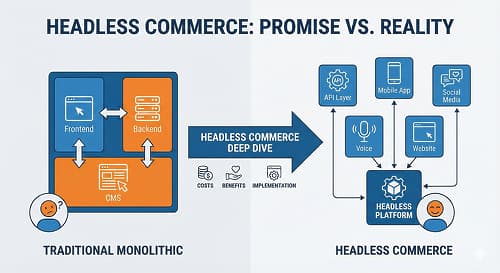
Headless commerce is an e-commerce architecture that decouples the frontend presentation layer (the "head") from the backend commerce functionality. Instead of a monolithic system where your storefront and backend are tightly integrated, headless architecture separates them completely.
In a traditional e-commerce setup like a standard Shopify theme, your frontend (what customers see) and backend (product management, checkout, inventory) are bundled together. Change one, and you often affect the other.
With headless commerce, these layers communicate through APIs (typically REST or GraphQL). Your frontend could be a React application, a mobile app, a smart display, or even a voice interface, while your backend handles all the commerce logic independently.
The Promise: Why Businesses Consider Headless
Unlimited Design Freedom
Traditional e-commerce platforms come with theme constraints. Even with extensive customization, you're working within a framework. Headless commerce removes these guardrails entirely.
You can build your frontend using modern frameworks like Next.js, React, Vue, or Angular. This means pixel-perfect designs, custom animations, and user experiences that aren't possible with traditional themes. For brands where differentiation matters, this is incredibly appealing.
Omnichannel Experiences
One backend, multiple frontends. That's the omnichannel promise of headless commerce.
Imagine managing your product catalog, inventory, and orders in one place while simultaneously powering:
- Your main website
- A mobile app
- In-store kiosks
- Smart display interfaces
- Social commerce integrations
- Marketplaces
Each touchpoint pulls from the same data source, ensuring consistency across channels. For businesses with complex multi-channel strategies, this architecture makes perfect sense.
Performance Optimization
Headless frontends, especially those built with frameworks like Next.js or Gatsby, can be blazingly fast. Static site generation, edge caching, and optimized JavaScript bundles can deliver sub-second page loads.
Google's Core Web Vitals have made performance a ranking factor. A well-implemented headless solution can significantly improve your SEO through better performance metrics.
Future-Proofing and Flexibility
Technology evolves rapidly. With headless architecture, you can swap out your frontend without touching your commerce backend, or vice versa. This flexibility reduces the risk of being locked into outdated technology.
Want to migrate from Shopify to another platform? With headless, your frontend stays the same—you just point it to a new API. Need to completely redesign your site? Your backend remains untouched.
The Reality: Challenges of Going Headless
Significantly Higher Development Costs
Let's talk numbers. A custom Shopify theme might cost $15,000-$50,000 depending on complexity. A headless implementation typically starts at $75,000 and can easily exceed $200,000 for enterprise solutions.
Why the massive difference? You're essentially building everything from scratch:
- Custom frontend development
- API integration
- Custom checkout experience
- Search functionality
- User authentication
- Product filtering and sorting
- Cart management
Features that come out-of-the-box with traditional platforms must be custom-built in headless environments.
Ongoing Maintenance Burden
A traditional Shopify store receives automatic updates, security patches, and new features from Shopify. With headless, you're responsible for maintaining your custom frontend.
This means:
- Regular dependency updates
- Security monitoring
- Framework migrations (React 17 to 18, Next.js upgrades, etc.)
- Breaking API changes from your commerce platform
- Browser compatibility testing
You need a dedicated development team or a reliable agency partner. This ongoing cost can be $3,000-$10,000+ monthly depending on your complexity.
Lost Platform Features
When you go headless with Shopify, you lose access to many built-in features:
- The native Shopify checkout (unless using Shopify Plus with custom storefronts)
- Many Shopify apps that depend on theme integration
- Built-in SEO features
- Automatic structured data
- Native multi-currency and internationalization
You can rebuild these features, but it requires time and money. Some functionality might be impossible or impractical to replicate.
Complexity in Analytics and Tracking
With traditional platforms, analytics are straightforward. Google Analytics, Facebook Pixel, and other tracking tools integrate seamlessly.
Headless adds complexity. You need to implement tracking across your custom frontend, ensure e-commerce events fire correctly, and maintain this as your codebase evolves. Simple tasks become engineering projects.
Longer Time to Market
Need to launch quickly? Headless probably isn't the answer. While a traditional store can launch in weeks, headless implementations typically take 3-6 months minimum, often longer for complex projects.
In fast-moving markets, this delay can be costly. Your competitors might capture market share while you're still building.
When Headless Commerce Makes Sense
Despite the challenges, headless commerce is the right choice for certain businesses:
Large Enterprises with Complex Needs
If you're doing $10M+ in annual revenue with complex multi-channel requirements, the investment in headless can pay off. You have the budget for proper implementation and ongoing maintenance.
Content-Heavy Commerce Experiences
Brands that blend content and commerce—think editorial magazines selling products or brands with extensive product education—benefit from headless. You can integrate a powerful CMS like Contentful or Sanity with your commerce backend.
Unique User Experiences
If your competitive advantage depends on a truly unique customer experience that traditional platforms can't deliver, headless enables that differentiation.
Mobile-First Brands
Businesses building mobile apps as primary shopping channels benefit from headless. You can share the same commerce backend between your app and web presence.
International Expansion
Companies expanding globally with different regional requirements, languages, and user experiences can leverage headless to manage complexity.
When Traditional Commerce Is Better
For many businesses, traditional platforms remain the smarter choice:
Small to Medium-Sized Businesses
If you're under $5M in annual revenue, the ROI on headless rarely makes sense. Traditional platforms like Shopify, BigCommerce, or WooCommerce offer excellent functionality at a fraction of the cost.
Quick Market Testing
Launching a new product or testing a market? Use traditional e-commerce to validate demand before investing in complex architecture.
Limited Technical Resources
Without a dedicated development team, maintaining a headless solution becomes problematic. Traditional platforms are designed for merchants, not developers.
Standard B2C Stores
Selling physical products with standard checkout flows? Traditional platforms handle this beautifully. The juice rarely justifies the squeeze.
The Middle Ground: Hybrid Approaches
You don't have to choose between fully traditional or fully headless. Several hybrid approaches offer benefits of both:
Shopify Hydrogen with Oxygen
Shopify's Hydrogen framework lets you build React-based storefronts while maintaining Shopify's managed checkout and backend. You get design freedom with less complexity.
Headless for Specific Pages
Many businesses go headless only for their homepage or product pages while using the platform's native checkout. This reduces implementation complexity while enabling custom experiences where they matter most.
Progressive Web Apps (PWAs)
PWAs offer app-like experiences without full headless architecture. You can build fast, engaging experiences while leveraging platform features.
Section-Based Customization
Modern Shopify themes with Online Store 2.0 offer extensive customization through sections and blocks. For many use cases, this flexibility suffices without going fully headless.
Key Questions to Ask Before Going Headless
Before committing to headless commerce, honestly answer these questions:
- What specific problem am I solving? "Headless is trendy" isn't a valid reason. Define concrete limitations you're facing with traditional platforms.
- What's my realistic budget? Include initial development ($75K-$250K+) and ongoing maintenance ($36K-$120K+ annually).
- Do I have technical resources? Either in-house developers or a committed agency partner for long-term maintenance.
- What's my timeline? Can I wait 4-6 months for launch, or do I need to move faster?
- What features do I lose? List platform features you use currently that won't work headless. Can you live without them or rebuild them?
- How will I measure success? Define concrete KPIs that justify the investment (conversion rate improvement, reduced bounce rate, increased mobile sales, etc.).
- What's my growth trajectory? Will your business scale into headless over time, or do you need it now?
Real-World Implementation Insights
Having implemented headless solutions for clients, here are practical insights:
Start with Your Backend
Choose your commerce backend first. Shopify Plus offers excellent APIs and managed checkout. BigCommerce provides robust headless capabilities. Consider your backend requirements before falling in love with a frontend framework.
Invest in Solid API Architecture
Your APIs are the foundation. Invest time in proper architecture, caching strategies, and error handling. A poorly designed API layer will haunt you forever.
Don't Reinvent Everything
Use pre-built solutions where possible. Frameworks like Shopify Hydrogen provide starter templates. Services like Algolia handle search better than most custom implementations.
Plan for Content Management
How will non-technical staff manage content? Integrate a headless CMS or build an admin interface. Don't assume developers will update content forever.
Test Extensively
With custom implementations, testing is crucial. Invest in automated testing, QA processes, and staged deployments. A bug in checkout costs real money.
The Verdict: Is Headless Worth the Hype?
Headless commerce is neither a universal solution nor empty hype. It's a powerful architecture that solves specific problems for certain businesses.
Worth it if:
- You have the budget ($100K+ initial, $50K+ annual maintenance)
- You have complex, unique requirements traditional platforms can't meet
- You have technical resources for ongoing development
- Your business scale justifies the investment
- You need true omnichannel experiences
Not worth it if:
- You're a small to medium-sized business without complex needs
- You need to launch quickly
- You lack technical resources
- Traditional platforms meet your requirements
- You're chasing trends rather than solving problems
The truth is that most e-commerce businesses don't need headless commerce. Modern platforms like Shopify have become incredibly flexible. Online Store 2.0, extensive app ecosystems, and customizable themes handle the vast majority of use cases.
For those with genuinely unique requirements, substantial budgets, and technical capabilities, headless commerce delivers on its promises. The key is honest assessment of your actual needs versus wants.
Before jumping into headless, exhaust your current platform's capabilities. Work with experienced developers to push boundaries within traditional architecture. You might be surprised what's possible without the complexity and cost of going fully headless.
If you do go headless, start small. Build an MVP, test with real users, and iterate. Don't try to rebuild everything at once. Successful headless implementations are evolutionary, not revolutionary.
The future of e-commerce likely includes both approaches. Choose based on your business needs, not industry hype. Sometimes the most cutting-edge technology isn't the right technology for your situation.
Tags
Comments (0)
Leave a Comment
No comments yet. Be the first to share your thoughts!